

COURSE DESCRIPTION
Dates
2026: 05.10.2026 – 10.10.2026
2027: 29.03.2027 – 03.04.2027 | 24.05.2027 – 29.05.2027 | 26.07.2027 – 31.07.2027 | 09.08.2027 – 14.08.2027 | 13.09.2027 – 18.09.2027 | 04.10.2027 – 09.10.2027
2028: To be announced (Ask for dates)
Intro
Are you ready to step outside the traditional classroom and explore learning through real-world experiences?
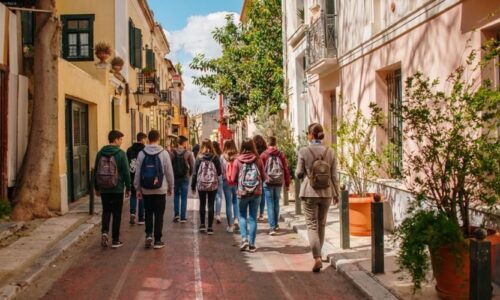
“Place-based learning” explores how local environments, cultural sites, and community spaces can become meaningful settings for learning.
The course includes a variety of practical activities, such as exploring historical and cultural sites, observing local environments, and taking part in community-based experiences. Participants will discover how places can inspire curiosity, reflection, creativity, and meaningful learning.
Who is this for?
This course is tailored for education, cultural and youth professionals of all levels – including teachers, leaders, counselors, mentors, camp leaders, extracurricular activity coordinators, and more – who want to harness the potential of place-based education.
No prior experience is required. Just curiosity and a willingness to explore local environments. Participants will benefit from an international learning experience while traveling with Erasmus+.
Objectives
By the end of this course, participants will be able to:
- Understand place-based learning: Explore the principles of learning through local environments, communities, and cultural spaces.
- Explore learning beyond the classroom: Experience how real-world places can provide opportunities for observation, exploration, reflection, and learning.
- Connect learning with place: Discover ways to relate educational experiences to the history, culture, environment, and everyday life of a local area.
- Develop reflective skills: Reflect on personal experiences and consider how learning in different environments can influence engagement and understanding.
- Explore local resources: Identify ways that local places, cultural sites, and community spaces can enrich educational experiences.
- Encourage curiosity and engagement: Explore how real-world experiences can stimulate curiosity, participation, and meaningful learning.
Modules
- Module 1: Introduction to place-based learning. Explore the principles of learning through local environments, cultural sites, and community spaces.
- Module 2: Stories of place. Discover how stories, memories, history, and local culture can be used to create meaningful connections with a place.
- Module 3: Learning through exploration. Participate in activities that encourage observation, discovery, and learning through real-world experiences.
- Module 4: Storytelling and creative expression. Explore storytelling techniques that can help participants interpret, share, and communicate experiences connected to a particular place.
- Module 5: Reflection and connection. Reflect on personal experiences and explore how different places can influence learning, perspectives, and understanding.
- Module 6: Bringing place into learning. Consider ways to incorporate local environments, cultural resources, and storytelling into educational experiences.
Course Outcomes
- Explore place-based learning: Discover how local environments, cultural sites, and community spaces can become meaningful learning settings.
- Connect learning with place: Explore ways to connect experiences with local history, culture, environment, and everyday life.
- Use storytelling to explore place: Discover how stories, memories, and personal experiences can deepen connections with the places around us.
- Experience learning beyond the classroom: Participate in activities that encourage observation, exploration, curiosity, and reflection.
- Develop reflective skills: Reflect on personal experiences and consider how different environments can influence learning and understanding.
- Discover local learning opportunities: Identify ways that local places, cultural resources, and community spaces can enrich educational experiences.
- Share experiences creatively: Use storytelling and creative expression to communicate experiences and ideas connected to place.
Equipment
Participants will need to bring their laptop to effectively utilize web-based tools and applications during the course.
See all available Erasmus+ courses we offer.
Destination:
Corfu is a beautiful green island, which enjoys a mild Mediterranean climate. Corfu is a very popular tourist destination. Up until the early 20th century, it was mainly visited by the European royals and elites. It is still popular with the global elite. The island’s history is laden with battles and conquests. Corfu was long controlled by Venice and repulsed several Turkish sieges, before falling under British rule following the Napoleonic Wars. Corfu was eventually ceded by the British Empire along with the remaining islands of the United States of the Ionian Islands, and unification with modern Greece was concluded in 1864 under the Treaty of London. Corfu is renowned for its long tradition and rich culture which is unlike any other Greek island. In 2007, the city’s old city was designated as a UNESCO World Heritage site. Here you will also discover a compact world of beautiful beaches and stunning mountain peaks, ancient ruins and picturesque villages. There is something for everyone on the island, whether you prefer peace and quiet or a lively cosmopolitan destination.
Pre-book this course! We will get back to you as soon as possible with further details. Reserve your place now!
Course Features
- Lecture 0
- Quiz 0
- Duration 1 week
- Skill level All levels
- Language English
- Students 15
- Assessments Yes